Gaussian Splats from 360 Camera Footage Outdoors
It was a bright, sunny day, and in 19 minutes we walked two and a half times round a swimming pool building with a RICOH THETA S on a pole. That gave 144 panoramas, one every 8 seconds. Structure from motion worked out where the camera stood for each of them, and from those poses I built three things: a mesh, a voxel model and a Gaussian splat. Only the splat turned out worth showing. The main lesson is about the way we shot, not the camera. We walked at a normal pace, so neighbouring shots ended up about nine metres apart. That is enough to place the camera and to train a soft splat. Multi-view stereo, which the mesh and the voxels are built from, needs shots much closer together.
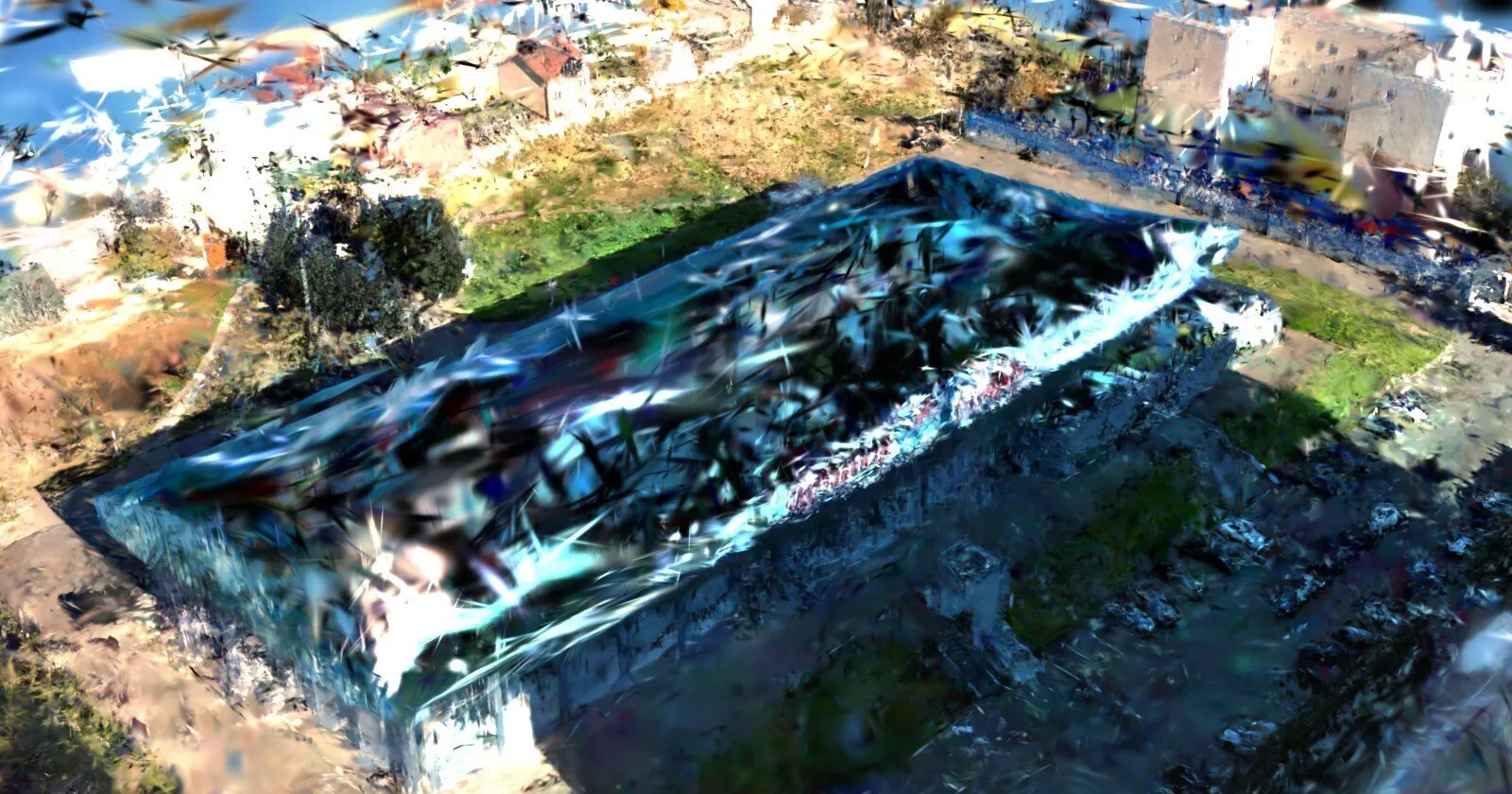
A word on units first. We had no tape measure, and the GPS of this session is useless (more on that below), so the model has no real metres. Every distance is measured in “lens heights”: the unit is the height of the camera above the ground. I did not measure that either. If the lens was at 1.7 m, five lens heights are those nine metres between shots.
This is the second session with this camera. The first was a kitchen, shot from a rover. For a model in real metres, tied to GPS, see the canyon post.
The walk
- Camera: RICOH THETA S (firmware 1.90) on a short pole held by hand.
- Photos: panoramas the camera stitches itself, equirectangular, 5376×2688. Interval shooting: 144 photos in 19.1 minutes.
- Exposure: automatic. Shutter 1/5000 to 1/1000 s, ISO 100–125; over the walk the exposure drifts by 2.3 stops.
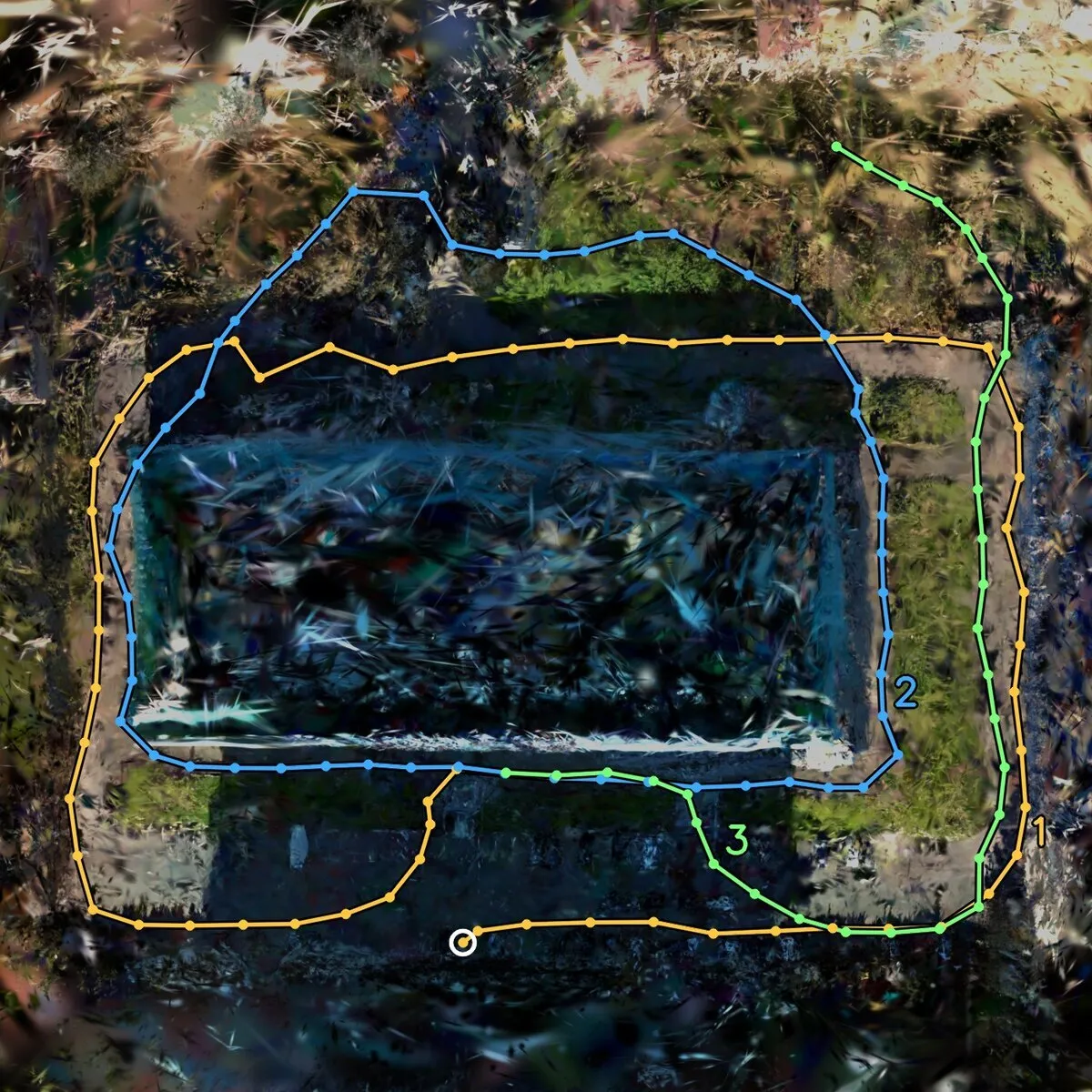
- Route: 2.4 times round the building. Two full loops (57 and 54 panoramas) and a third pass along the front and one side (32 panoramas). 768 lens heights in all.
- People: two of us walked with the camera, and we are in every shot.
The 8-second interval turned out to be the weak point. At walking pace that is 5.2 lens heights between neighbouring shots (the median), the nine metres above. Along the long facade that makes about 14 shots per pass, along the short one about five. In the kitchen, for comparison, neighbouring shots were centimetres apart. Next time I would stop for every shot and take one every 3–4 metres.
How it was computed
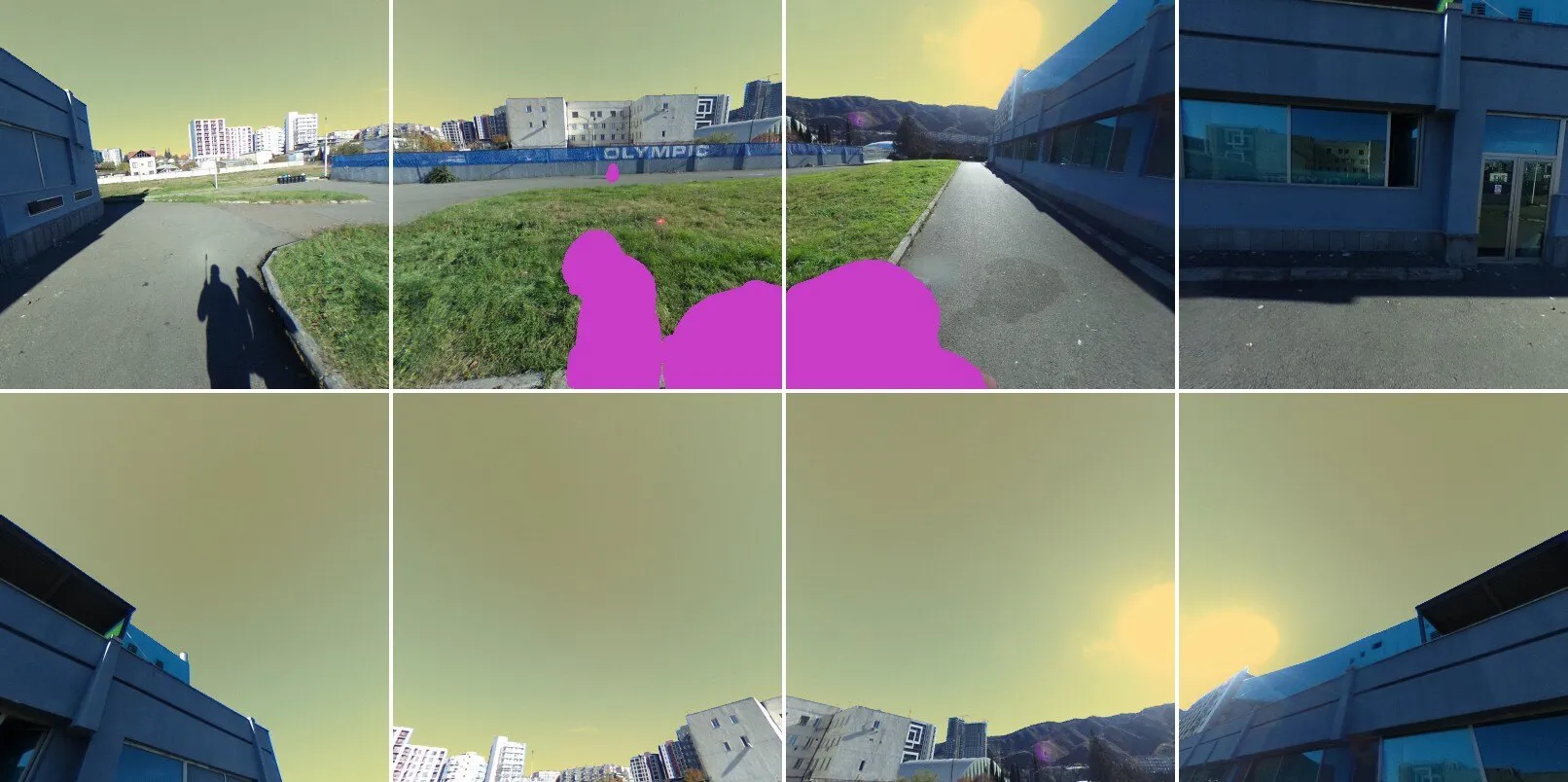
From a panorama to ordinary frames. COLMAP, which I use for the poses, cannot work with spherical images. So each panorama is cut into 8 ordinary perspective frames, “faces” (90°, 1600 px): four look round the horizon tilted 10° down, four look 50° up. All eight share one centre, and COLMAP gets them as one rigid camera rig. All it has to find is the position and rotation of the panorama as a whole.
Every frame has the two of us in it. We walk with the camera, so we stay in the same place in every shot and contradict everything around us, which moves. The sky is a different problem: there is nothing in it to hold on to. So a segmentation network (UperNet on ConvNeXt-L, ADE20K classes) masks people and sky on every face. People take up to 14% of the faces that look back, the sky 72–77% of the upward ones.
Where the camera stood. Comparing every face with every other would take too long: 658,944 pairs. Instead each panorama is matched with the next eight and with the eight most similar ones anywhere in the walk. The second group is there to recognise a place we already passed on an earlier loop and close the loop. That leaves 25,175 face pairs, and they contain 699 loop closures. SIFT and matching run in COLMAP 3.11; the reconstruction is built by the rig-aware mapper of pycolmap 3.13. In 16 minutes it placed all 144 panoramas (1152 faces) in one model: 127,842 points, mean reprojection error 1.40 px at a focal length of 800 px, which is 0.074°.
A small reprojection error only says the model agrees with itself. To check it independently I computed the poses with a second solver, OpenMVG, which handles a spherical camera directly. The camera centres agree to 0.22% of the walk’s length (rms), the rotations to 0.34° (median). One panorama did not agree. It was taken under pine trees, had only 97 points, and COLMAP had put it 17 lens heights off the walk, with a perfectly normal reprojection error. I removed it.
The splat. A Gaussian splat describes the scene as a cloud of semi-transparent coloured blobs, Gaussians, and fits them so that a render matches the photos. I trained it with gsplat 1.4 and MCMC densification: 2.5 million Gaussians, 40,000 steps on the faces at 1200 px, 25 minutes on an RTX 4090. Settings that worked in a room did not work outdoors. This is what had to change:
- Sky. The sky has no geometry, so it lives in a separate learned panorama, 256×128, “at infinity” behind all the Gaussians. It learns from sky pixels only. When I first let it learn from every pixel, it started explaining a blurred average of the whole scene. The Gaussians were no longer needed and faded out, and at step 2000 the training died.
- Units. gsplat’s step sizes and MCMC noise are tuned for a scene about one unit across, so the training runs in coordinates divided by the scene’s size. In lens heights the same run scored 14.5 dB instead of 17.2.
- Penalties. The penalties on opacity and size apply only to the Gaussians visible in the current frame. When they applied to all of them at once, about half had faded by step 4000.
- Start. Training starts not from nothing but from 92 k points of the sparse model and 652 k points of the stereo cloud.
- Exposure. The camera changed its exposure by itself, so each panorama gets its own learned colour gain.
Mesh and voxels. Both are built from depth maps. First, COLMAP’s PatchMatch looks for depth using neighbouring shots, on 589 faces at 768 px (1 h 52 min). Where it found nothing, a neural network that estimates depth from a single image fills the gaps (Depth Anything V2, metric outdoor); its scale is fitted to the PatchMatch depth on each face. TSDF fusion in Open3D turns these maps into a mesh. The voxel model drops the same maps into a grid of cubes 0.1 lens heights across, clears the space the cameras saw through, and keeps the cubes seen by at least two panoramas.
What came out
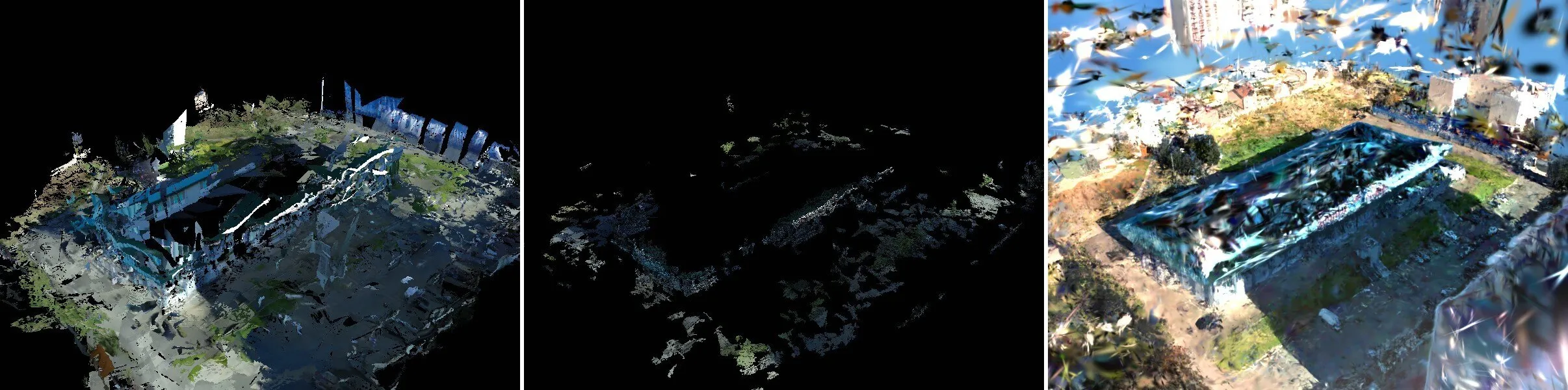
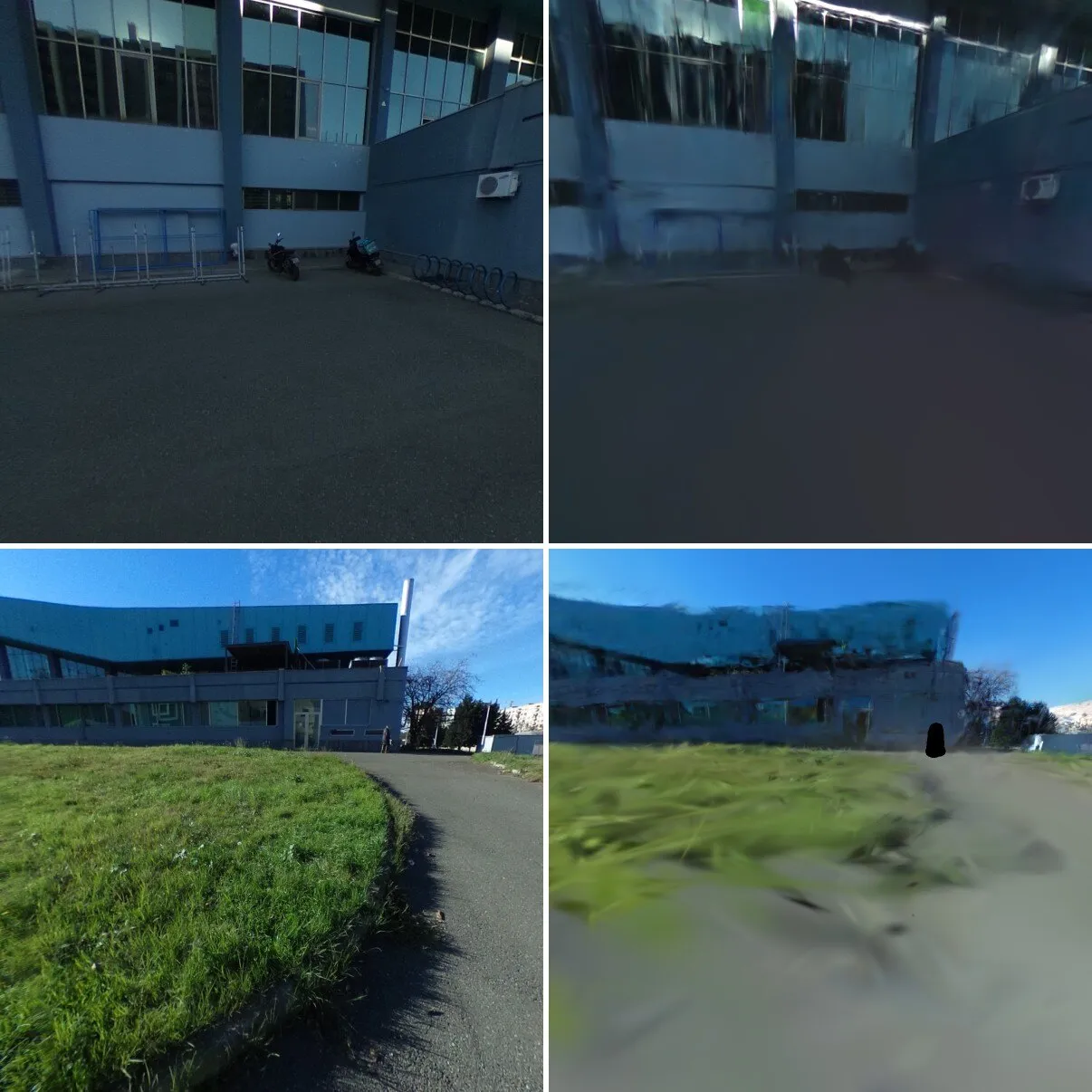
Fig. 4 shows all three results from the same point. The mesh is made of scraps, the voxel model is islands, and the splat shows the whole site.
| method | what it gives | quality | why |
|---|---|---|---|
| Gaussian splat | views from anywhere, raised ones too | the site reads from above; soft close to the camera | it is fitted to the photos directly: a poorly seen surface turns into blur, not into a hole |
| mesh | surfaces: 16.1 M triangles | facades and window bands read, the edges are ragged; covers 64% of what the real frames show; far buildings come back as phantom sheets | PatchMatch kept 13% of the pixels, the rest is depth guessed from a single image |
| voxels | occupancy: 206 k voxels | the facades stand, the ground is patchy | of 3.19 M surface voxels, 2.95 M were seen by fewer than two panoramas |
How far to trust the splat
A nice render proves nothing on its own, so the splat is checked on panoramas it never saw during training. A test panorama is always held out whole, all eight faces at once. There are three tests, from easy to hard:
- between: every eighth panorama; its neighbours on both sides are trained on;
- beyond: the last 5 panoramas, where the walk leaves the ground already covered;
- third pass: a separate splat trained on the first two loops only (111 panoramas) and tested on all 32 panoramas of the third pass. These views come from another time and another line on the ground.
| test | panoramas | nearest trained shot, lens heights (median) | PSNR, dB | SSIM | LPIPS |
|---|---|---|---|---|---|
| between | 17 | 4.4 | 17.2 | 0.61 | 0.48 |
| beyond | 5 | 11.7 | 14.5 | 0.39 | 0.53 |
| third pass | 32 | 3.8 | 16.2 | 0.53 | 0.49 |
Higher is better for PSNR and SSIM, lower for LPIPS. PSNR and SSIM are computed on scene pixels, without sky and people; LPIPS (AlexNet) on the whole face, sky included. One caveat: in every test the poses and the starting points come from all panoramas; the test ones are left out of the splat training only. For scale: in the kitchen the “between” test scored 35.0 dB. Here it is 17: the picture is recognisable, but soft.
Within the third pass, distance to where the camera has already been decides everything:
| third-pass panoramas | count | PSNR, dB | SSIM | LPIPS |
|---|---|---|---|---|
| within 2 lens heights of a trained shot | 9 | 17.4 | 0.64 | 0.44 |
| 2 to 8 lens heights | 17 | 16.3 | 0.53 | 0.50 |
| 10 to 17 lens heights (the walk leaves the loops) | 6 | 14.2 | 0.37 | 0.55 |
Even right next to the trained path there is no miracle. At 0.1–0.4 lens heights from a trained shot, a view from another pass scores 18–19 dB, while the trained views themselves score 23.4 dB.
Why the splat worked and the mesh and voxels did not
The main reason is the capture itself: the shots are too sparse. Everything else only makes it worse.
- Sparse shots. PatchMatch keeps a depth only where neighbouring shots confirm each other. For that, a piece of wall has to look almost the same in both, and from points nine metres apart it is seen at noticeably different angles. In the end 13.1% of the pixels kept a depth (kitchen: 55%). A mesh from that depth alone covers 3% of what the real frames show.
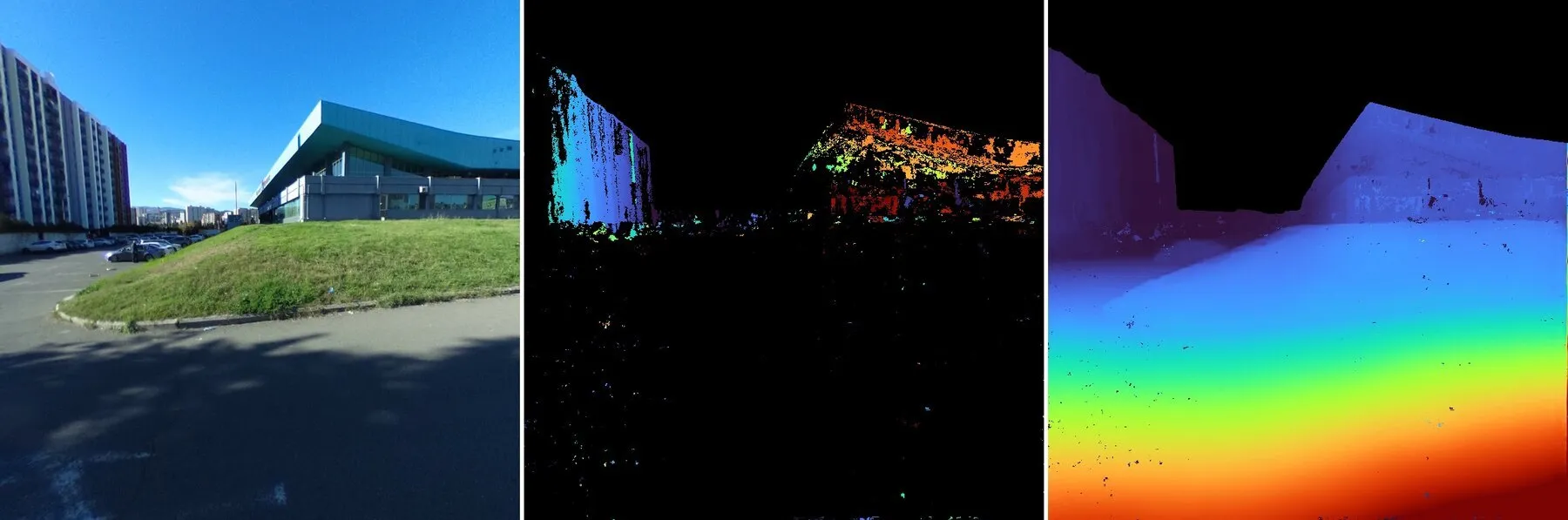
- Ground without texture. Fig. 6 shows what PatchMatch could hold on to: the facade and the tower block in the distance. On asphalt and grass there is almost no depth. Glass is a separate story: the window band mirrors the buildings opposite (fig. 3). I did not measure what stereo does there.
- A network is not a second viewpoint. The depth network fills 98% of the pixels, but a second panorama confirms only 18% of what it fills (67% for PatchMatch pixels).
- Sky and people. They are masked in all three products. But before the fix described above, the sky alone broke the splat.
- Exposure. The learned gains of the panoramas span 1.5 stops. The splat compensates for that; the mesh and the voxels take the colours as they come. I could not tell the camera’s two lenses apart in the stitched stills.
The same sparse capture hurts the splat less. It does not need every pixel confirmed by a neighbouring shot: it is fitted to all the photos at once, and a poorly seen place comes out blurred rather than empty.
Limits
- No metres. The THETA S has no GPS. The phone wrote coordinates into the photos, but there are only three distinct positions in 144 shots. The building is 71.0 × 24.8 lens heights between facade lines, and a single tape measurement would turn that into metres. The depth network puts the lens at 1.66 m (median), but from face to face the estimate wanders from 0.6 to 3.2 m. That is a hint, not a scale.
- The seam. The camera stitches each panorama from two hemispheres. Within 5° of the seam the reprojection error is the same 0.074°, but only 2% of the keypoints there become 3D points, against 8–9% away from it. Part of that is simply what happens to lie along the seam.
- One session. One building, one hour of light, a low sun. The roof was never in view.
- The scores are low. 17 dB means “recognisable”, not “photoreal”.
What I’d do next
- Shoot more often: a frame every 3–4 metres (2 lens heights), plus one more loop farther from the building.
- Or shoot video with a current 360 camera. Video gives a frame every few centimetres of the walk, and the spacing can be chosen after the fact. The THETA S records video at only 1920×1080 for the whole sphere, almost three times coarser than its own stills.
- Lock the exposure.
- Raise the camera above head height: fewer people in the frame, more ground.
- Use the raw frames of the two fisheye lenses, if a camera gives them. The seam disappears, and the camera becomes a true two-camera rig.
- Get a scale: one measured distance, or a GPS that actually updates.
- Try surface-oriented splats (2DGS, PGSR) to get geometry out of the representation that worked.
- Shoot the roof from above: a drone, or a 4–5 metre pole.
Code and data
The whole pipeline is in format37/theta-360-recon:
one YAML per session, one script per step, and every number in this post collected in the run’s
summary.md. The 144 panoramas are on
Hugging Face together with our run, for comparison. People in them are painted out, cars blurred,
and the GPS is stripped from the files.